
“My child just wants to do Art all day and I’m worried that they are avoiding new opportunities that could grow their creativity in ways they don’t even know about. What can I do to help them branch out of their comfort zone this summer?”
Many children love Art and use it as a way to relax and do something that feels fun, safe, and has been successful in the past. It seems appropriate to help stretch a child’s skills and creativity by honoring this skill strength and helping them to grow within it and outside of it. The challenge is how to do this in a respectful manner while still keeping Art fun!

I suggest you consider three options:
- Provide a variety of Art materials that your child may not have used or used in combination before.
- Stretch the things that they actually do with these materials to encompass more complicated projects
- Try new things that are close to Art but not exactly art such as building or science experiments.
Provide a variety of art materials
Let’s consider the first. Use different art mediums: colored pencils, crayons, paint (watercolor and poster paint), chalk, pens, clay, and so on. Try lots of kinds of bases to work onto as well. You can use xerox paper, construction paper, cardboard from packing boxes, or spread out a long sheet of brown paper over a picnic table for a freer art option. Try doing art on cardstock of various colors or even pieces of scrap wood.
Art can be small or large. It can be something that is permanent or something that washes away, such as a watercolor outside on the sidewalk. Paint with different things: brushes you would use to paint a house, thin watercolor brushes, wide brushes, Q-tips. Try putting a bunch of them together with a rubber band for a different effect. Add a cheap comb to the painting experience one day and see what happens, or decide to paint only with parts of your hand: fingertips, knuckles, palms, and so on. Inviting a friend over can help get the creative juices flowing, as can taking an art class. Again, it is always more fun with a friend.
Stretch the way materials are used
How might you stretch the way art materials are used? Here are a few examples!
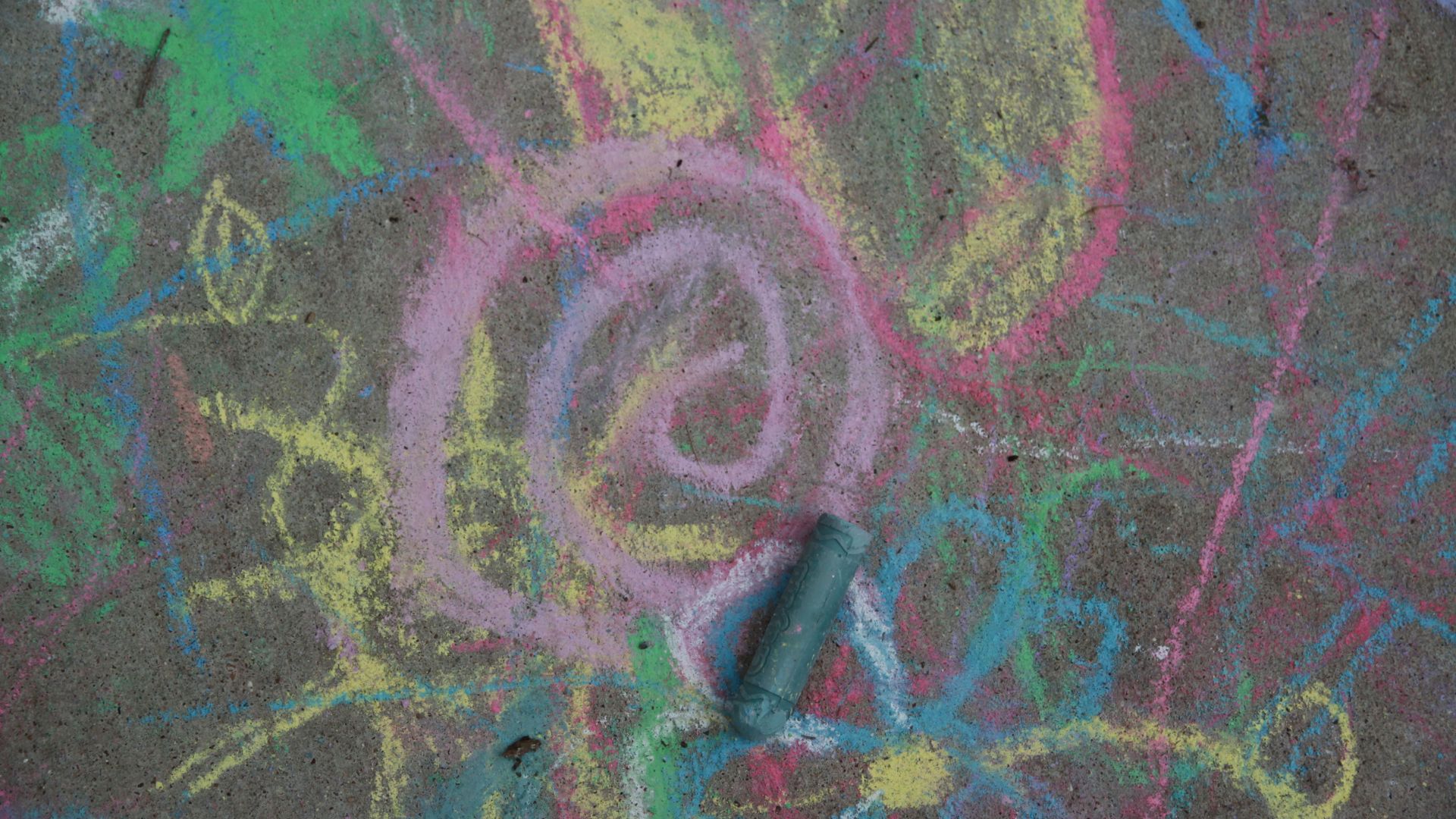
Follow your child based on their age and interest. You might use water as an art medium to paint on the sidewalk using a big brush. What about painting the side of a fence or the house? Now add some food coloring to the water. Let’s try it in a spray bottle and see if you can make a picture. If you turn the nozzle, you can sometimes make a stronger spray. What if you add a stencil on the ground and spray inside the stencil? Now add sidewalk chalk. Can you grind it into a powder and mix it with water to make a different kind of paint? The possibilities are endless!
Let’s talk about making collages using a flat base, liquid glue, and things around the house. Paper is obvious, or that wrapping paper from a gift that is too dilapidated to be reused. What about some pieces of yarn, string, or ribbon? Children love to cut as part of their creating! You could provide craft scissors with decorative edges. As they come in a set, just put out one or two pairs at a time.

Try new things that are close to art
Summer or school breaks are a great time to try new things. These might be art adjacent.
Colored sidewalk chalk outside might morph into ground-up chalk mixed with water to paint cardboard signs. Those signs might invite friends to a puppet show where she sewed her own puppets!
If your child loves to string beads to make jewelry, you might show them how to make flower chains to wear as jewelry. These may become part of a costume they and their friends wear to entertain you with a song they love to sing or a dance they enjoy performing.
Building is often well received by creative children, especially if it is incorporated into performances or fort making. These can be decorated with chalk, washable markers, or even embroidered if the children are so inclined. In this way art is woven into all forms of play, but the play is expanded and art is not the only thing your child is doing!
If fiber arts are enticing, what about round loom knitting to make a hat for herself? Or learn to do finger knitting and make a rug for her doll house or a mat for her dresser. If you do not know how to do these crafts, there are many videos on the internet that show you step by step.

Cardboard creating provides endless opportunities for creation. There is even a cardboard saw available that will cut cardboard shapes but not children’s fingers, the Chompsaw, along with reusable cardboard connectors. These creations can be painted!
And while we do not want our kids on screens for a significant amount of time, researching fun crafts together such as origami, watercolor techniques, finger knitting, or simple jewelry making is a great way to use the internet to help. And don’t forget about those premade kits that are for sale this time of year! They are great to have on hand as well, to pull out when you need something interesting and new. Sometimes they lead to lifetime interests!
Don’t forget about books! There are lots of books that show ideas for art projects and give step-by-step directions. Explore these with your child and offer them to your child to explore independently! Read about artists as children as well as adults. Provide books or artists’ work for your child to peruse and possibly emulate. The possibilities are endless.
The adult’s job
The job of the adult is simply to provide the creative materials, dole them out at a reasonable pace, and ask probing questions. “I wonder what might happen if…” Then watch as the magic happens!
And if you are wondering whether all this art is coming at the expense of academics, take heart. This kind of open-ended, hands-on work is building real skills: concentration, planning, problem-solving, fine motor control, and early science and math thinking. Honoring a strength is often the surest path to stretching a child in every other direction too.

Cathie Perolman, M.Ed
Cathie Perolman is a reading specialist, elementary educator, author, consultant, and creator of educational materials for primary and elementary students.
You can see all her original materials for sale in our shop, and read more about her and her life’s work here.
